iPEN
  • Home
  • iPEN
  • Training
    • Making sense of impact
    • Te Ao Māori and Impact
    • Clarifying the problem context
    • Planning for impact
    • Developing impact pathways
    • Tracking your impact
    • Extending your impact toolkit
    • Communicating your impact
  • Resources
    • iPEN's Resources
    • Other resources
    • Impact News
    • Professional community
    • Glossary
  • Contact us

Impact News

We know there is lots going on out there and it's hard to keep track!
 Here we share news, webinars, training, or anything else impact-related we think potentially useful.

writing a good policy brief - a template!

3/21/2023

2 Comments

 
​The fundamentals of achieving impact from research, is getting the knowledge and information that is contained (usually) in academic research publications into the hands and heads of the next and end user - the people who can start applying that knowledge.
 
This means a different audience, and with that a need to change how you’re communicating, so you’re speaking their language. 
 
As researchers, a key audience for us are policy makers. They might be involved in operational policy (setting rules and guidelines for how things get done), or strategic policy which is much more about setting the overall rules of the game (like legislation).
 
In either case, someone who works in policy needs the ‘so what’ bits of your research provided to them in as short but comprehensive a way as possible. 
eIf you google ‘policy brief templates’ there is no shortage of options and it can be confusing where to start, and how relevant the advice might be for our context.

Recently, the Riddet Institute has funded Dr Hannah McKerchar to undertake an internship with the Prime Minister's Chief Science Advisor.
 
Her project has been focused on exploring how to improve the use of research evidence and connections with policy in the area of food sustainability regulations in Aotearoa, and as part of this internship Hannah has produced some great resources to help researchers effectively engage with policy makers.
Picture
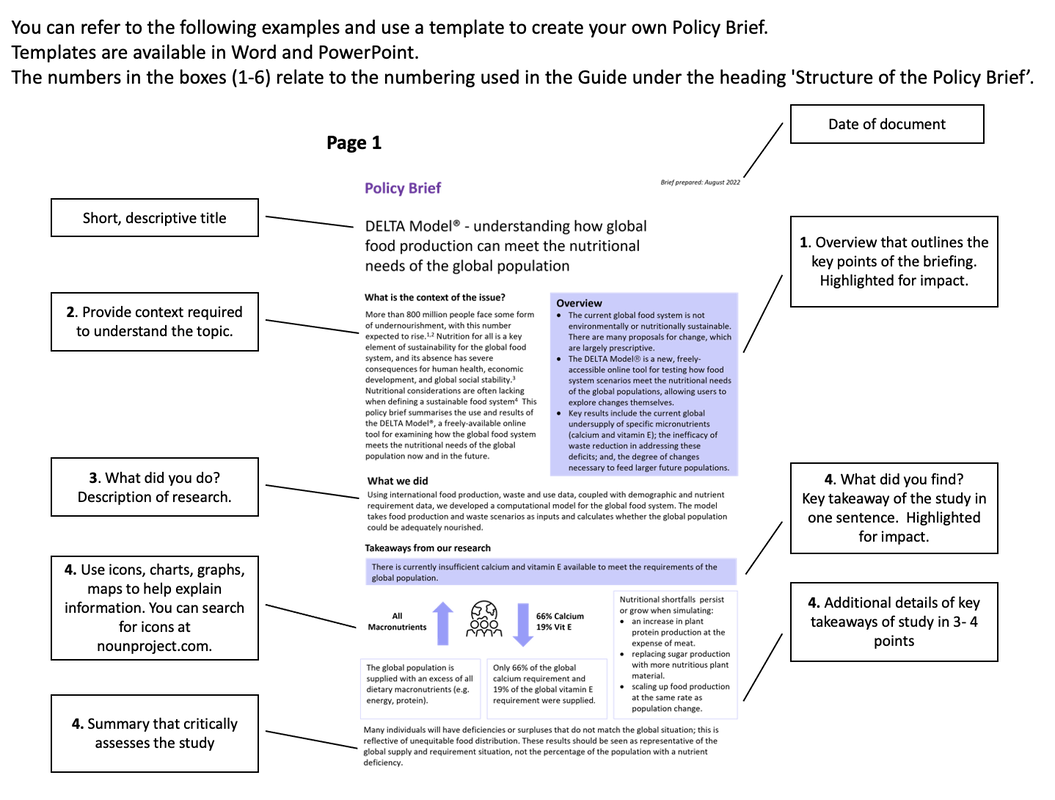
What’s great about this resource is Hannah has developed two short explanatory videos, and included some really helpful completed examples, where you can see how the tips play out when summarising a real piece of research. 
 
All the templates and videos can be found here. We suggest watching the second video first. In this video they talk about a number of the kinds of challenges and issues we also talk about in our own training, and is a helpful reminder that these are the kinds of challenges anyone working in research experiences. 

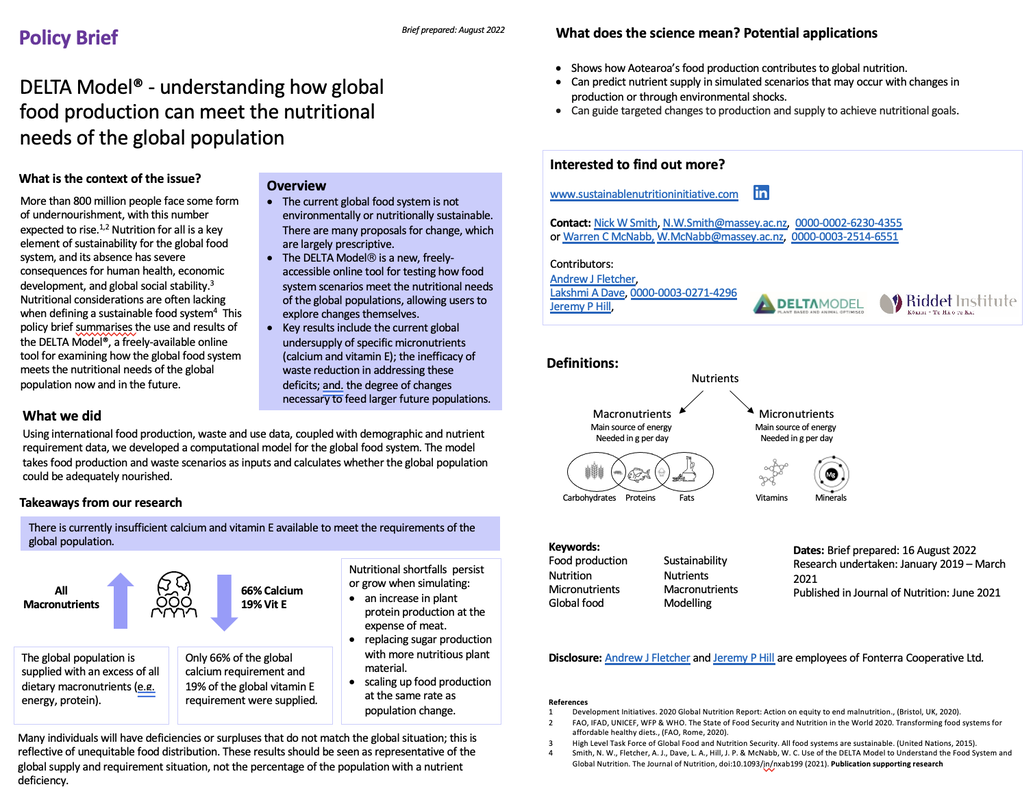
Although you can find the full guide here, we suggest you download and review the DELTA example first. In this example you can see exactly how they’ve completed the policy brief with two additional pages of explanation. 
The CellAg example then shows another example of a completed brief.
Picture
Picture

What is really helpful with both these examples is they’ve been drafted as what is the classic ‘one-pager’.

Anyone who’s worked in or with government knows that if you can’t summarize it on an A3 page, you’re probably going to loose your audience, so these are a particularly helpful resource for the New Zealand context.
2 Comments
Tel U link
6/19/2023 09:25:31 pm

What are some effective ways to grab the attention of policymakers and make them engage with a policy brief?

Reply
Chanel Partridge (iPEN Coordinator)
7/27/2023 01:15:14 pm

On behalf of Hannah McKerchar.

Start with your immediate network of colleagues, collaborators and friends and consider whether they have relevant connections, or know someone that does, to make an introduction to a policymaker. Relationships of trust are hard won and take time, don't expect to glide in. Mutually beneficial relationships engender engagement, being humble and offering to help with information is a good tact to take. Beyond your personal network, you can utilise the network of CSAs for the target ministry or agency, they are great advocates for research. Lastly, you can make a cold call, which can either reap huge rewards or not eventuate in anything. If you choose this path, consider what you have to offer them, what you are willing to provide, be humble, gracious, and clearly communicate that you value their time. Start with brief intro (your organisation, position and one sentence explaining your research), why you are contacting them (read article, are at relevant organisation) and what you want them for (coffee, phone call, answer a specific questions). Drawing attention to published material in the popular press, eg The Conversation, that policy people might have seen, can also help establish a connection.
Many of these tips are found in Evans, M.C., Cvitanovic, C. An introduction to achieving policy impact for early career researchers. Palgrave Commun 4, 88 (2018). https://doi.org/10.1057/s41599-018-0144-2, check it out for more practical suggests to achieving policy impact.

Reply


Leave a Reply.

    Author

    iPEN is a collaboration across all seven Crown Research Institutes in New Zealand. We're a collection of colleagues all working towards supporting greater impact from our science and research.

    Archives

    December 2024
    October 2023
    July 2023
    April 2023
    March 2023
    February 2023
    December 2022
    November 2022
    October 2022
    September 2022
    August 2022
    June 2022

    Categories

    All
    Call To Action
    Communicating Impact
    Impact
    Irrigation Insight
    National Science Challenge
    Our Land And Water
    Progress Studies
    Reflective Practice
    Research Impact
    Storytelling

    RSS Feed

Home
Picture
Contact Us
  • Home
  • iPEN
  • Training
    • Making sense of impact
    • Te Ao Māori and Impact
    • Clarifying the problem context
    • Planning for impact
    • Developing impact pathways
    • Tracking your impact
    • Extending your impact toolkit
    • Communicating your impact
  • Resources
    • iPEN's Resources
    • Other resources
    • Impact News
    • Professional community
    • Glossary
  • Contact us